How Exhibition Agencies Can Win More RFPs With Faster, Higher-Quality Booth Concepts
Agencies don’t lose RFPs because they lack creativity — they lose because the early concept phase is too slow, too vague, or too hard for the client to believe.
When a prospect is comparing three agencies, the one that helps them see the idea clearly (and quickly) tends to win. That doesn’t mean “pretty pictures”. It means credible, on-brand concepts that feel buildable, priced realistically, and aligned to the brief.
This article breaks down a practical approach agencies can use to increase RFP win rate by improving speed, clarity, and confidence in the concept stage — without burning out the design team.
Why RFPs are won (or lost) in the concept stage
Most RFP decisions are made before detailed design starts. Clients shortlist based on:
- How well you understood the brief (and the brand)
- How clearly you communicated the idea to non-design stakeholders
- How confident they feel that it can be delivered on time and on budget
- How quickly you can iterate when feedback inevitably changes things
If your concept output is slow or ambiguous, you create space for doubt — and doubt kills momentum.
The 5 levers that improve RFP win rate
1) Speed to first credible concept
The first agency to show a credible direction often sets the benchmark.
What “credible” looks like:
- Correct scale and layout logic for the stand size
- Brand cues that feel intentional (not generic)
- A clear “hero moment” (structure, content, or experience)
- A layout that supports the business goal (demo, meetings, lead capture)
Tip: Aim for a first concept that’s good enough to start decision-making, not perfect enough to build.
2) Present options that are meaningfully different
Clients don’t want ten variations of the same idea. They want a few distinct strategic routes.
A strong option set typically includes:
- Content-first concept (screens, messaging, proof points lead)
- Architecture-first concept (form, structure, silhouette lead)
- Experience-first concept (interaction, demo flow, engagement lead)
This makes the client’s job easier: they can choose a direction, not nitpick details.
3) Make the concept easy to sell internally
Your buyer is rarely the only decision-maker. They need assets that help them get sign-off.
Include:
- Multi-angle views (front, corner, rear) so nothing feels hidden
- Close-ups of key moments (demo zone, reception, product wall)
- A simple narrative: goal → idea → how it works → why it wins
If the concept is hard to explain, it’s hard to approve.
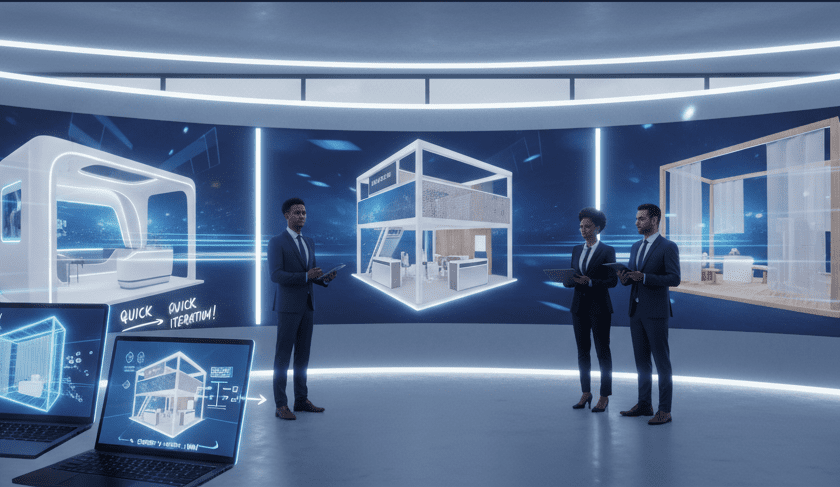
4) Build iteration into the process (not as a painful surprise)
RFPs change. Budgets change. Stakeholders change.
The agencies that win are the ones that can respond fast without restarting.
A practical iteration loop:
- Lock the brief assumptions (stand size, open sides, must-haves)
- Generate a direction set (2–3 concepts)
- Get stakeholder selection (pick one route)
- Iterate only the chosen route (layout, messaging, features)
- Package a pitch-ready deck (visuals + rationale)
5) Reduce risk with “human-in-the-loop” quality control
AI can accelerate concept generation, but agencies win when the output is trustworthy.
That means:
- Someone checks brand accuracy (colours, tone, product cues)
- Someone checks feasibility (structure, materials, lighting, access)
- Someone checks the story (does the design support the objective?)
Speed matters — but confidence matters more.
A simple RFP concept package that converts
If you want a repeatable deliverable for RFPs, build a package like this:
- 1 hero perspective (the “this is the idea” shot)
- 3–5 supporting angles (to remove uncertainty)
- 2 close-ups (proof of detail and intent)
- A top-down floorplan view (flow and zoning)
- A 30–60 second motion video (optional, but powerful for stakeholder buy-in)
This is the difference between “a concept” and “a pitch asset”.
Where ExpoBooth.ai fits (without replacing your team)
ExpoBooth.ai is designed to help agencies produce pitch-ready booth concepts faster — with human oversight to keep outputs on-brand and buildable.
Teams use it to:
- Turn briefs, moodboards, sketches, or CAD into credible concept directions
- Generate multi-angle renders and close-ups for proposals
- Create cinematic motion videos that help clients get internal approval
- Make near-instant changes when feedback comes in
It’s not about replacing designers — it’s about removing the slow, repetitive parts of early-stage concepting so your team can focus on the creative decisions that win.
Quick checklist: are you set up to win more RFPs?
- Do you deliver a credible first concept fast enough to keep momentum?
- Do your options represent different strategic directions (not minor variations)?
- Can a non-designer explain your concept in 30 seconds?
- Can you iterate quickly without restarting?
- Do your visuals feel buildable and brand-accurate?
If you can confidently tick those off, your RFP win rate will follow.