Case Study: 4 Exhibition Booth Design Iterations in 178 Seconds
The headline result
178 seconds. That’s how long it took to go from:
- Initial concept
- Custom textures applied
- Bespoke furniture added
- Rebranded to a new colour palette and look
Four design iterations. One cohesive vision. In under 3 minutes.
For most exhibition teams, that same loop takes days (sometimes a full week) because every change request becomes a new queue, a new round of revisions, and a new delay.
This case study shows what changes when the workflow is built specifically for exhibition design — and when speed doesn’t come at the expense of consistency.
The situation: a familiar revision spiral
If you’ve ever supported a pitch or proposal, you’ll recognise the pattern:
- A designer creates the initial concept
- Stakeholders request changes
- The designer revises
- Someone asks for furniture tweaks
- Then branding changes
- Then the client wants “one more option”
Each iteration is reasonable on its own. The problem is the time cost.
- Waiting for the next revision slows momentum
- Decision-makers lose context between rounds
- The pitch window shrinks
- Teams settle for “good enough” because exploring more options becomes too expensive
The goal
Deliver a pitch-ready concept that:
- Maintains design integrity across edits
- Stays on-brand even when branding changes mid-stream
- Allows stakeholders to iterate freely without resetting the whole design
- Produces visuals that are proposal-ready, not just “idea sketches”
The approach: exhibition-specific AI + human oversight
ExpoBooth.ai is built around a simple principle: exhibition design has rules.
It’s not just about aesthetics. It’s about:
- Consistency across angles and revisions
- Layout logic that respects stand constraints
- Materials, textures, and lighting that feel believable
- Design decisions that remain coherent as you iterate
And because pitches need reliability, every output is supported by a human-in-the-loop process to ensure the result is credible, on-brand, and usable in client-facing work.
What happened in 178 seconds (step-by-step)
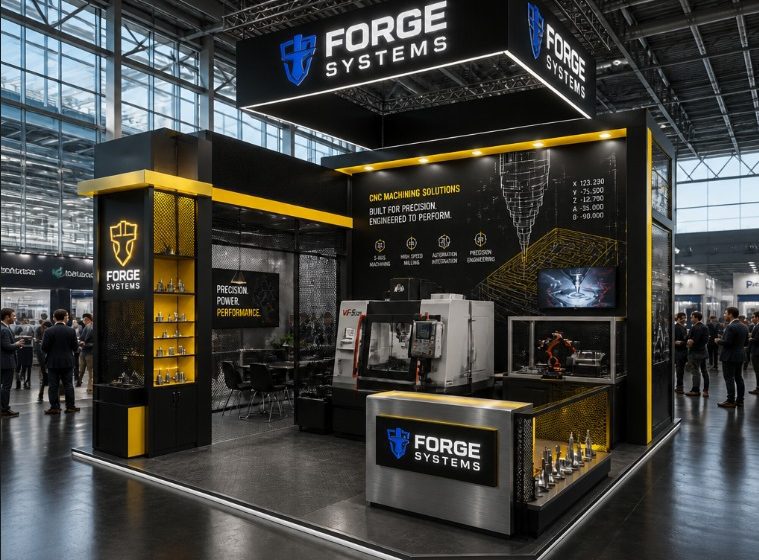
Iteration 1: Generate the concept
A base booth concept was generated from the initial direction.
Outcome: a clear starting point with a defined structure and visual identity — enough to begin stakeholder discussion immediately.
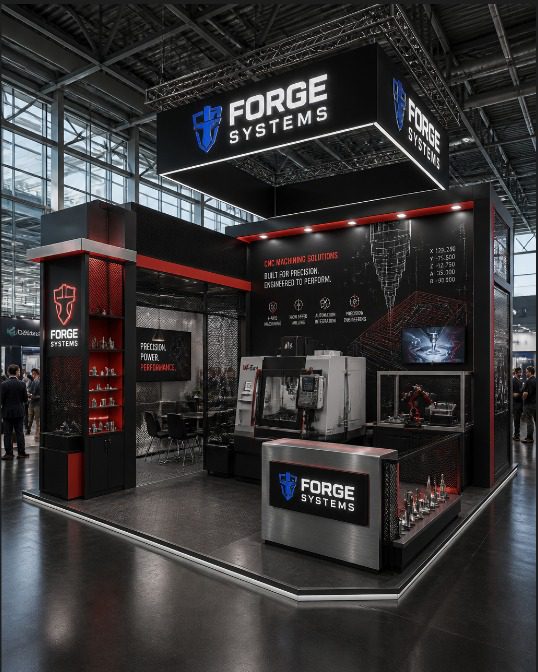
Iteration 2: Apply custom textures
Materials and textures were updated to match the desired finish and style.
Outcome: the concept moved from generic surfaces to a more realistic, brand-appropriate look.
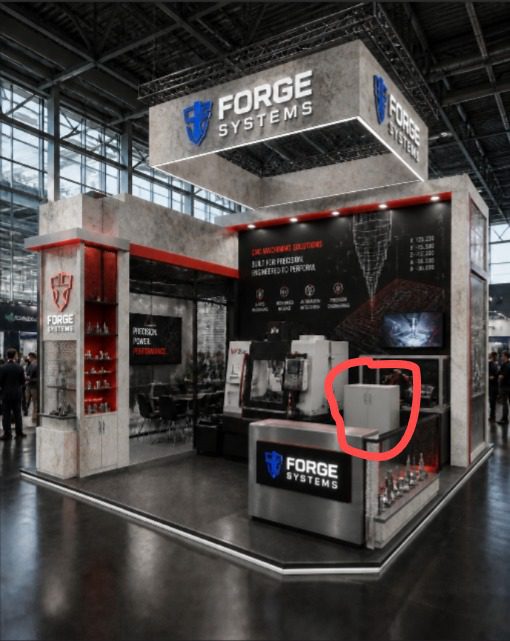
Iteration 3: Add bespoke furniture
Custom furniture elements were introduced to support the intended experience (reception, meeting, demo, or product interaction) – see red circle above!
Outcome: the booth became more functional and more “real” — not just a shell, but a space designed to perform.
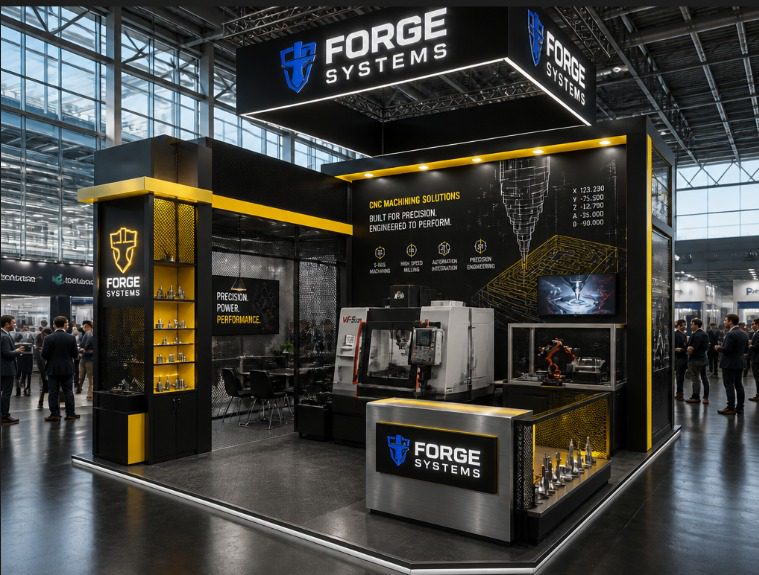
Iteration 4: Edit to match new branding
The concept was reworked to align with a new brand palette and updated look.
Outcome: the design stayed cohesive — the same idea, now re-expressed in the new brand language.
Why this matters (beyond speed)
The obvious win is time. But the bigger change is what that time unlocks.
1) Clients can actually explore options
When iteration is fast, you don’t have to gamble on one direction.
Clients can:
- Compare routes
- Pressure-test ideas
- Make confident choices
- Commit earlier
2) Stakeholder approval becomes easier
Fast iteration keeps everyone aligned while the idea is still fresh.
Instead of:
- “We’ll come back next week with revisions”
You can do:
- “Here are the revised options — now — which one are we taking forward?”
3) Pitches become fundamentally stronger
When you can iterate freely, you can deliver:
- More polished visuals
- More strategic options
- Better alignment to the brief
- A clearer narrative
That changes what’s possible in a pitch — and what clients start to expect.
The old way vs the new way
When this workflow is a perfect fit
This approach is especially useful when:
- You’re working to a tight RFP deadline
- The client’s brand direction is still evolving
- Multiple stakeholders need to approve the concept
- You want to show options without multiplying cost
- You need proposal-ready assets (renders, angles, close-ups, motion)
The takeaway
178 seconds isn’t just a speed flex.
It’s proof that exhibition concepting can move at the pace of decision-making — without sacrificing consistency.
When your clients can iterate in minutes, they don’t just get a faster design.
They get a better one.