

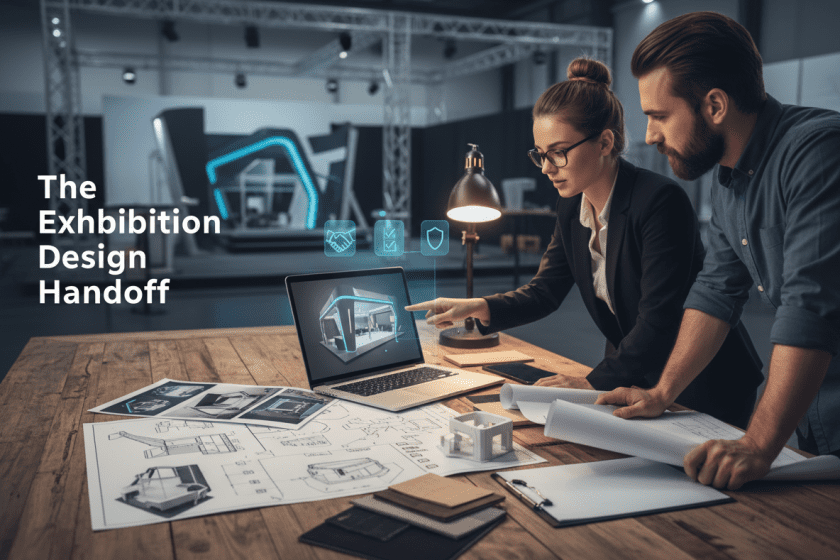
The Exhibition Design Handoff: How to Brief Stand Builders So Your Concept Doesn’t Get Value-Engineered
You’ve seen it happen.
The concept looks incredible. Stakeholders approve. The pitch deck lands. Everyone’s excited.
Then the stand builder comes back with a quote… and the next version looks like a different booth.
This isn’t always a “bad builder” problem. It’s usually a handoff problem.
When builders don’t have enough clarity on what’s essential (and what’s flexible), they’ll reduce risk the only way they can: simplify, standardise, and remove complexity. That’s how strong concepts get value-engineered into something safer—and less effective.
This article is a practical handoff framework for agencies, exhibitors, and creative teams who want the booth that gets built to match the booth that got approved.
Why concepts get value-engineered
Value engineering happens when any of these are true:
- The builder doesn’t know what the “hero” is (so they cut the wrong thing)
- The concept lacks build intent (materials, structure, tolerances)
- Budget expectations aren’t explicit
- Venue constraints are unknown (rigging, height, fire regs)
- The design has no priority order (everything feels equally important)
Your goal in the handoff is to remove ambiguity.
The 3-layer handoff model (what builders actually need)
A clean handoff has three layers:
- The story (what the booth must communicate)
- The experience (how visitors move, engage, and convert)
- The build (how it can realistically be fabricated and installed)
If you only hand over pretty renders, you’re missing layer 3.
1) Define “non-negotiables” vs “flex zones”
This is the single most important step.
Create two lists.
Non-negotiables (must stay)
Examples:
- The overhead ring/canopy is the hero brand moment
- The demo theatre must seat 8–10 people
- The LED wall must be visible from the main aisle
- The meeting area must feel quiet and premium
Flex zones (can change)
Examples:
- Material finish options (timber vs laminate)
- Storage location (as long as it’s accessible)
- Feature wall thickness
- Furniture spec
This gives builders permission to optimise cost without killing the concept.
2) Provide a “budget reality” range (even if it’s uncomfortable)
Builders can’t protect your concept if they don’t know the budget gravity.
Give a range and a preference:
- Target build budget: £X–£Y
- If we need to cut: protect A and B first
- If we can invest: upgrade C and D
Even a rough range is better than silence.
3) Share the concept in multiple views (not one hero render)
Builders need to understand geometry and intent.
Provide:
- 3–5 key angles (front, both sides, rear, interior)
- A top-down zoning view
- One “visitor eye-level” view from the main aisle
If you have walkthrough-style visuals, even better—builders spot issues faster when they can “move” through the space.
4) Add an annotated “build intent” sheet
This is where most handoffs fail.
Create one page that calls out:
- Primary materials and finish intent (premium matte metal, fabric, timber slats)
- Structural assumptions (supported canopy vs rigged)
- Lighting intent (warm premium vs bright retail)
- AV intent (LED wall size, demo screens, audio needs)
No need for engineering drawings—just clear intent.
5) Include operational requirements (so the booth works on show day)
Builders don’t just build a structure—they build an operating environment.
Include:
- Expected staff count on-stand
- Demo frequency and capacity
- Lead capture method (QR, badge scan, forms)
- Storage needs (giveaways, bags, coats)
- Accessibility requirements
This prevents “looks good, works badly” outcomes.
6) Confirm venue unknowns and assumptions
If you don’t have the exhibitor manual yet, state what you’re assuming.
Examples:
- Height assumed at 4m pending venue confirmation
- Hanging sign assumed not permitted
- Power feed assumed from rear-right floor box
Builders can quote more accurately when assumptions are explicit.
7) Ask for two quotes: “as designed” and “optimised”
This is a pro move.
Request:
- Option 1: As designed (closest to concept)
- Option 2: Optimised (cost-reduced, but must preserve non-negotiables)
This keeps the conversation constructive and avoids surprise redesigns.
Where ExpoBooth.ai fits
ExpoBooth.ai helps teams generate high-quality, pitch-ready booth concepts quickly—but the real advantage is what happens next: a clearer handoff.
When you can produce multiple angles, walkthrough-style visuals, and structured concept packs (with human oversight for brand accuracy), builders get better inputs—and you get fewer “that’s not what we approved” moments.