Exhibition Booth Design Trends for 2026: What’s Actually Working (and What’s Just Noise)
Every year, the exhibition world gets a fresh batch of “trends”. Some are genuinely useful. Others look great on LinkedIn… and fall apart under real show conditions.
This guide is written for event agencies, stand builders, and exhibitors who want booth concepts that win attention and convert—without adding unnecessary complexity.
1) Zoning that matches the visitor journey (not a pretty floorplan)
What’s working: stands designed around what visitors actually do: approach, orient, engage, convert.
- Clear “front-of-stand” hook (message + visual)
- A single primary action (demo, scan, book, talk)
- A natural path from busy to quiet (open engagement → deeper conversation)
What’s noise: layouts that look balanced in 2D but create bottlenecks, awkward queues, or dead zones.
2) “Content-first” structures (LED is the architecture)
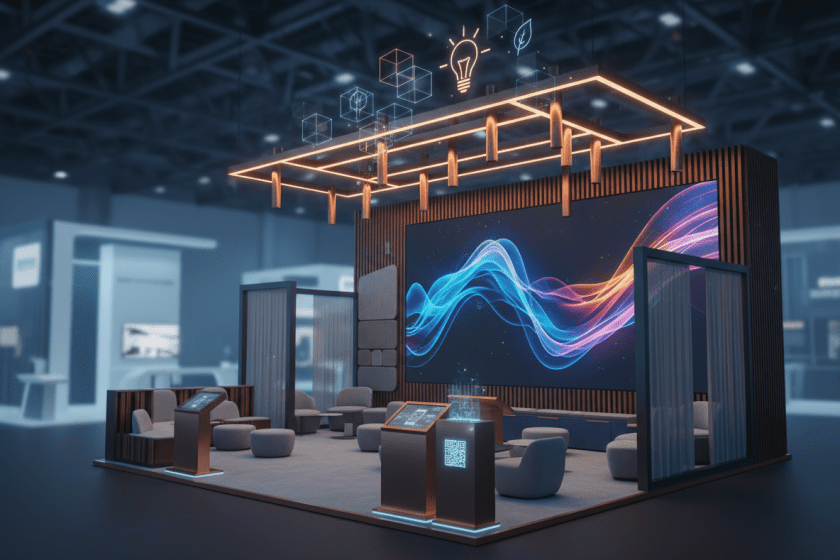
What’s working: using content surfaces—LED walls, transparent LED mesh, projection, or modular lightboxes—as the main architectural feature.
Why it performs:
- Content can change by region, product, or show day
- You can reuse the structure and refresh the story
- It’s measurable (what content drives stops and conversations)
What’s noise: giant screens with generic loops and no message hierarchy. If people can’t understand what you do in 3 seconds, the LED is just expensive wallpaper.
3) Modular + premium hybrid builds
Budgets and sustainability pressure are pushing teams away from fully custom one-offs.
What’s working: hybrid systems—modular frames with premium “hero moments” (feature arch, canopy, demo theatre, material focal point).
Benefits:
- Faster build and easier touring
- Better cost control
- Less waste
- Still feels bespoke where it matters
What’s noise: “modular” stands that look like modular stands because the hero moment is missing.
4) More immersive pre-show selling (walkthroughs before the booth exists)
This is a big shift: teams are using walkthrough-style visuals to sell the concept internally and align partners before production.
What’s working:
- Walkthrough videos for stakeholder buy-in
- Multi-angle renders for decision-making
- Clear zoning visuals to validate flow and capacity
What’s noise: static moodboards that don’t answer practical questions (scale, sightlines, queueing).
5) “Quiet premium” materials and lighting
After years of “more neon, more gloss, more everything”, premium brands are leaning into restraint.
What’s working:
- Warm, controlled lighting
- Textured materials (timber, fabric, matte metals)
- Fewer finishes, better executed
What’s noise: over-designed surfaces that photograph well but are fragile, hard to clean, or impossible to maintain across a multi-day show.
6) Micro-experiences instead of one big gimmick
Visitors don’t have time for a 10-minute brand story. They do have time for a 30–90 second micro-experience.
What’s working:
- Quick interactive demos
- “Before/after” product moments
- Live mini-sessions on a tight schedule
- Clear takeaways (scan to get the asset, book the meeting)
What’s noise: big experiential features that create queues but don’t create qualified conversations.
7) Better lead capture design (it’s part of the concept now)
Lead capture is finally being treated as a design problem.
What’s working:
- Lead capture placed where conversations naturally end
- QR-first assets (one scan, one clear next step)
- Staff zones that support quick handoffs
What’s noise: hiding lead capture behind counters or making it feel like a form-filling exercise.
8) Feasibility-led creativity
The best concepts in 2026 are creative and buildable.
What’s working: concepts that consider:
- venue rules and height limits
- rigging and weight
- power and AV
- accessibility
- logistics and touring
What’s noise: “AI-generated wow” that can’t be built, can’t be quoted, and can’t be approved.
Where ExpoBooth.ai fits
ExpoBooth.ai helps agencies and builders move faster from brief to pitch-ready visuals—without sacrificing real-world constraints.
- Generate multiple concept directions quickly
- Produce high-quality renders and cinematic visuals for buy-in
- Stress-test zoning and flow before production
- Keep brand accuracy with human oversight
If you’re planning your 2026 show calendar, the best advantage isn’t a trend—it’s speed + clarity. The teams that iterate faster (and approve faster) will win more.